Ben Stark was on Limited Resources with a very interesting thesis: there is a solid blue control deck lurking somewhere in All will be One. Blue is widely derided as the worst color and it is performing very poorly in the 17Lands stats. Yet it’s commons look like everything a control player could dream of. What’s going on here?
Read moreBrothers’ War: Best Commons
Sadly I had to miss the pre-release event due to “family” and other “reasons”. We’re postponing sleep training Baby Narset until after our overseas trip in a week, which is proving to be a bit grueling. The best part is that every time I attempt to force the conversation with Benalish Momma, Baby Narset–sensing danger–immediately sleeps 6+ straight hours. Very crafty.
Onto the magic cards. There’s usually a very clear subset of Best Commons (aka Signals) just from the spoiler. Reasonably efficient or instant-speed removal, cantrips, and efficient creatures always make for good Signals because they usually fit into any deck archetype. Let’s see what we’ve got.
red
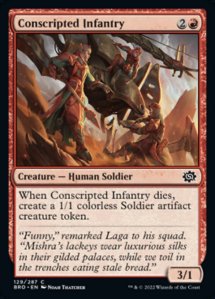

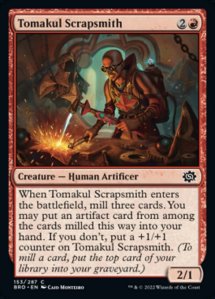


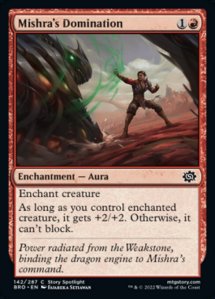
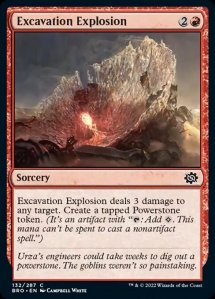
Some thoughts on deckbuilding
I had a really fun draft the other day that was unusual. Usually I find the drafting to be the fun part and the deck construction to be straightforward, but this one was reversed. A very straightforward draft into a UG lane led to some Interesting Choices in deck construction. Let’s go through the steps of taking a pile of cards into a deck
Sticking to your bombs
I’ve been quiet posting, as it’s been one of those months where I felt like I had to choose between writing about magic or just… playing Magic. I honestly don’t see how content creators manage it at all. But I had a good coaching session with Ethan (of Lords of Limited) and he had some really interesting feedback on one of my drafts.
the draft

So let’s talk Westgate Regent, shall we? Despite sounding like a mid-range business hotel, it’s a powerhouse card the likes of which Sengir Vampire can only dream. It’s… pretty close to an Quadrant All-Star. It breaks board stalls, is reasonably priced, its Ward defense almost ensures a 2:1 if oppo has removal for it, and it snowballs ridiculously. And I was fortunate enough to open it.
Read moreKaldheim Top Commons
For Kaldheim, my New Set Resolution is to get more disciplined in my pick-orders. I usually have a good sense from listening to the podcasts and consuming content, but I don’t really formally study them and force myself to think about the difficult “A…or B?” choices ahead of time. And then I panic with 0:06 seconds left on the clock before making a choice. In a first for me, I actually went through the set blind and judged the cards, looked (a little) at the context, and tried to pick out the top three in each color. Let’s get to it!
white
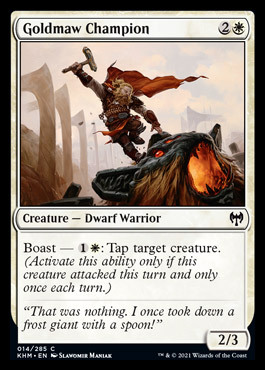


These are the five that jumped out at me. Territorial Hammerskull was an absolute beater, but I’m not sure if paying two mana for the same effect is going to get there. Axgard Braggart attacks as a 4/4 on turn 5 (when spending the two mana is less of a tax) and threatens to run away from the game if left unchecked. Iron Verdict is a pretty decent removal, but only when on defense or racing. Bound in Gold is our Pacifism for the set, bland but reliable. I’m actually highest on Gods’ Hall Guardian. 3/6 Vigilance is keyword: big for sure and there are a LOT of enhancements in this set (runes, equipment etc.) which scale very nicely on a creature that is playing both sides of the ball.
Gods’ hall guardian || Bound in gold || axhard braggart
blue
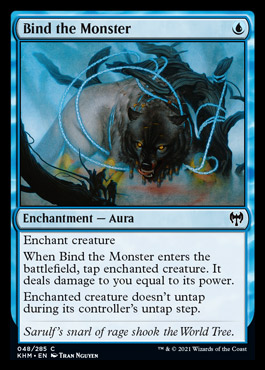


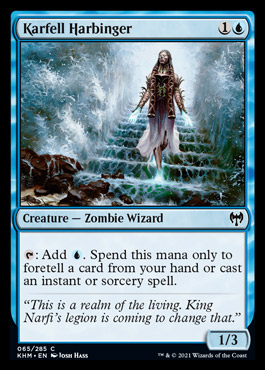
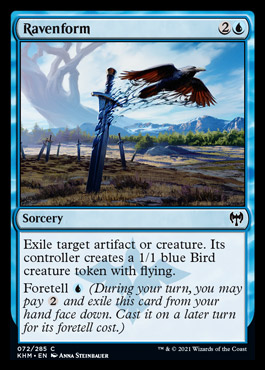

Blue has a bounty of riches to choose from! One mana removal (albiet one that damages you), a Phantom Monster on an installment plan, bounce, a mana-dork that can also defend early, another flexible removal spell, and a very interesting little flier that can loot for you too. I think the unconditional removal is clearly in the top two. As for the third, I think the Pilfering Hawk is going to overperform. As a flier, it wears pants (enchantments and runes and equipment) really well and asking for just a single snow source to loot is pretty reasonable.
bind the monster || ravenform || pilfering hawk
black


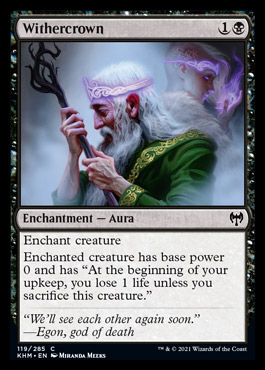


Black is pretty hard to read. Well, the three excellent pieces of removal aren’t that hard to read. 4-mana unconditional instant-speed removal is gas. The other two are more odd: one is efficient but can’t be played without something in the graveyard, which slows it down. The other is a slow drain but the creature can still stick around to block if you’re around. Still, I think most decks would happily run either of them.
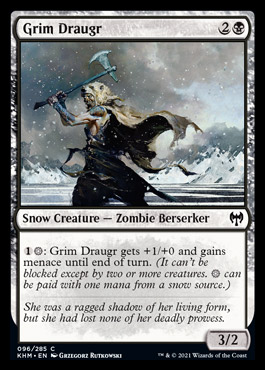
The creatures are weirder. A ‘cast two’ payoff that can get ridiculous in a hurry, but clearly has a deckbuilding cost. Koma’s Faithful looks to be in slower decks, as a blocker that can trade up aggressively and stock the graveyard AND gain some life as a buffer. Finally, Grim Draugr looks like an absolute beater that can attack as a 4/2 with menace with relatively little work. So black looks to be doing a little of everything!
feed the serpent || weigh down || withercrown
red


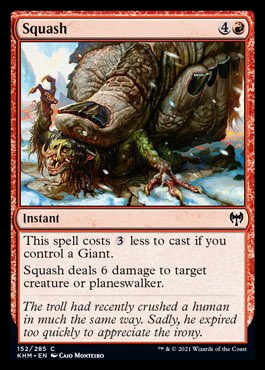
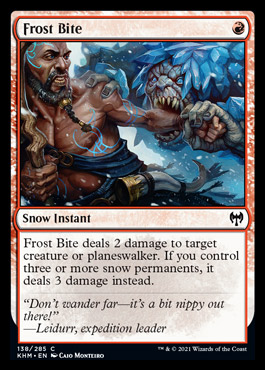
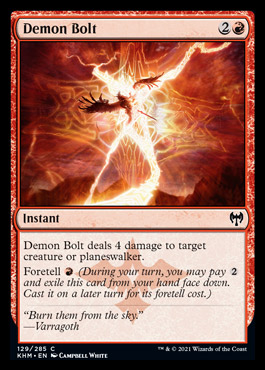
So which direct damage spell is your favorite? Ah red: never change. The first question is how easy will it be to have three snow permanents (note: not JUST snow lands) to upgrade Frost Bite from Shock to OG Lightning Bolt (that can’t go to the face). Demon Bolt being able to pay on the installment plan is a strong contender. And Squash (great name) hinges on how easy it is to get a Giant on the battlefield (red has two at common). The 3-drop that draws you cards (sort of ) for 1 mana I think is going to shockingly overperform, though I don’t think it’ll make the medal podium. Finally, the equipment that is a Short Sword that also pings the opponent could really rack up the damage and enable some attacks. Since red appears to be exclusively turning cards sideways, I think it’ll find a home in every deck.
Frost Bite vs. Demon Bolt is a close one. If snow is easy to put together, I think the higher ceiling on Frost Bite bumps it to the #1 slot. If there’s only one or two “snow” drafters at the table, then it’ll probably be Demon Bolt. Which is where I’ll start.
demon bolt || frost bite || tormentor’s helm
green
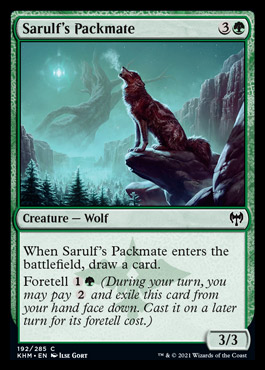

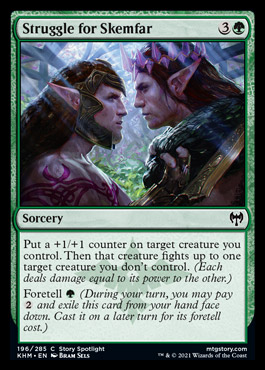

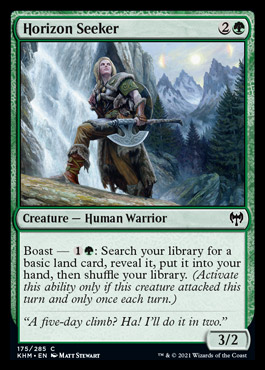
Green is interesting. Elvish Visionary keeps getting stronger, since now we’re up to a Hill Giant that draws you a card AND can be paid in installments. Glittering Frost I think is going to be a key component of Snow decks, since it creates two snow permanents and generates two pieces of snow mana. Hunt the Weak I think will be fine. The Troll Warrior looks to have a super scary threat-of-activation that will be hard to block. Finally, a 3-mana go-get-a-land that will also–almost certainly–trade for a card looks to almost be a 2-for-1 more often than not. I see a lot of splashing in green’s future!
glittering frost || horizon seeker || icehide troll
Okay! There it is! My best theorycraft without doing my usual cheating on LR and other set reviews. Let’s see how these hold up, what changes in context, &c &c. Thanks for reading.
White removal, Continued
It was brought to my attention that I completely overlooked a piece of iconic removal.


Okay, well the first lesson is that I’m an idiot and not to be trusted. It is interesting how recent these cards are though. Righteous Blow is from Avacyn Restored and then this paradigm lay fallow until Impeccable Timing reappeared in Kaladesh. However, once I got over my embarrassment (and my rationalization engines started kicking in) I started to wonder, are these cards really removal? Or… is it just a combat-trick on steroids? Let’s compare:


So, what are the differences between these two cards? Interestingly, Bladebrand’s cantrip nature isn’t terribly important. Since your creature is almost certainly going to die, you’re just replacing the creature with a card from your library. Imagine if Bladebrand read: “Sacrifice a creature. Destroy target attacking or blocking creature.” I would argue that it would play nearly exactly the same way. They both function relatively similarly on your attack, since the attacker is still blocked. There is more difference on defense. Bladebrand needs a creature whereas I.T. can wipe out an attacker without board presence, a key advantage for I.T.
There are some other minor differences: Bladebrand also works better with your first-striking creatures and is worse when facing first-striking creatures. Bladebrand can bring down an opposing bomb (as long as you can block it) whereas I.T. really can’t. But they have the key similarity that they *don’t* hit creatures that aren’t engaging in combat. Since those are often the creatures that you need to kill most (Risen Reef etc.), that’s a major functionality gap.
When evaluating removal, it’s worth breaking down the four dimensions of What Removals Does For You.
- Removing oppo’s blocker
- Killing utility creatures
- Answering opponent’s bombs
- Handling oppo’s aggressive attackers.
Weigh these four variables against the cost. The reason why Lightning Strike is so fantastic is that it aces three of these tasks, only falling short on answering an opposing bomb, at the very reasonable cost of 2-mana. Consign to the Pit does do all four of these, but at 6-mana the cost is significantly more prohibitive.
Given how Impeccable Timing (and its peers) only handle three of these functions, I think they should be evaluated more as combat tricks. Since they do wipe out early attackers, they are helpful for control decks. But the inability to hit utility creatures, not removing blockers, and decreasing utility against Big Bombs, is enough to tip the scales to “Not Removal”.
 Benalish Dad