intro!
Draft log

Okay, time to delve in and draft the Snow Life. Or at least draft-respecting-the-power-of-snow-life. The goal is to not just pick “strongest card vs. best fit” but also “better or worse than the available snow land”. Maybe there will even be a challenging P1p1 to really make it complete.

So I don’t really do cube. There are several reasons for this. It always seems to land right around times where I’m busy and/or need a break from magic (i.e. the holidays). The time-investment to familiarize myself with the cards, the ‘known combos’ &c is just too steep. Also, I highly suspect that my inner Spike would trump my Johnny and I would just be the fun-police with RW aggro over and over again, promising to either win or lose by turn 5.
This is an elaborate setup to explain why Kaldheim has felt really difficult for me lately. My happy-place drafting is Gruul in RNA. You curve, you have tricks, you beat people in the face with a clear plan. I get a little less comfortable in control decks, as I’m not as conversant with the ingredients, but I can get the job done. The more prince-y a format is, with powerhouse bombs that you have to figure out how to make work, the more I fall apart. And now drafting lands is a major priority since the Snow payoffs in this set are pretty real. Which brings up to Kaldheim.

I was listening to LR when LSV quasi-jokingly referred to this card as “Cruel Ultimatum“, the classic game-ending-but-impossible to cast. Normally, a card requiring WUBRG+2 would be categorized as unplayable in Limited. But this set is grindy enough–and dual-landsy enough–that it’s one of the best uncommons, a virtual four-for-one. That presupposes that you already did you homework, snagged dual-lands, and did a lot of heavy thinking. In short, you drafted like a cube draft.
I had a good coaching session with Ethan where he made a really interesting point. In most formats, “5-color Good Stuff” is your emergency parachute when a draft goes off the rails. Take some mana-fixing, take best available cards, and hold on for dear life. In Kaldheim, “5C Good Stuff (with Snow)” is Plan A. That snow lands can both fix and provide an additional avenue of power really makes a difference. Again, this is very far from my traditional draft approach of find a lane and put the pieces together. Or rather, I need to open my mind to the “5C Snow Lane” which doesn’t look like a traditional two-color pairing.
The other thing that Ethan recommended I work on is try to aggressively identify when the Snow Land is the “best card” in the pack. Obviously it’s not the best card per se, but rather a necessary stepping stone to the 5C Snow Lane. Sultai lands are the best, dual-snow are really good, plains are pretty useless. So let’s see how I did on the first try here
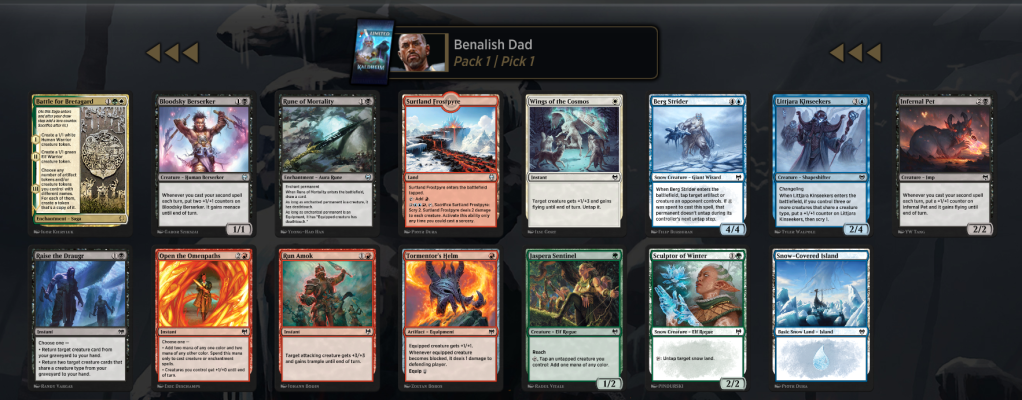
Huh, I guess it stopped capturing P1p1 again. Well an easy Elvish Warmaster, solid Quadrant Theory All-Star since it’s good at literally every stage of the game.
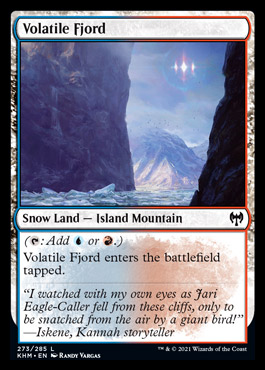


Okay well P1p2 was the first hard choice. Rune of Might is good and it follows the rare nicely versus a dual-land in the Temur colors. I honestly don’t know what I should have picked here.
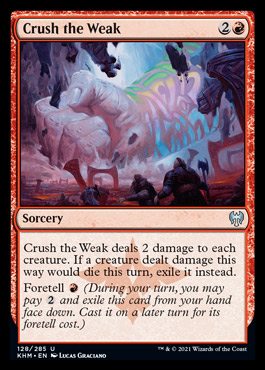
P1p3: Took Crush the Weak, though I would have taken any non-plains snow dual over it.


P1p4: Ooof, this is getting harder. Not great green in the pack but a reasonable dual is in the pack along with the best black common. I took the land here, but maaaaaybe you take Feed? I can already see this is going to be hard.
Snow lands dried up after that with some decent blue that I didn’t take (Mistwalker being the big signal)

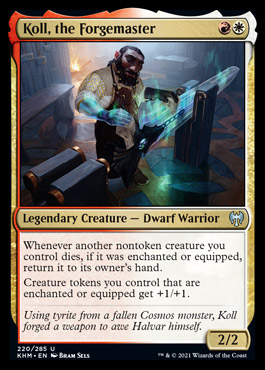
Lost round one to Koll and a single Goldvein pick with the lifelink rune. Man that card is good (Koll). Really speaks to the grindy nature of the format that just constantly recycling creatures is nigh-unbeatable.

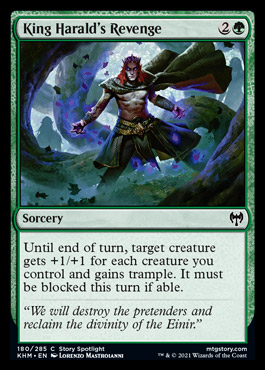
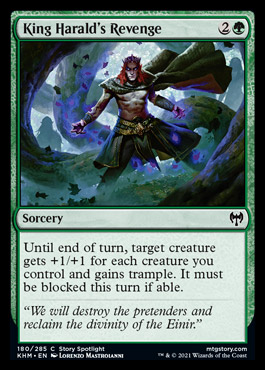
Round two didn’t go much better, facing UW. game 2 I had a pretty sweet Alpha Strike with the Warmaster giving +2/+2 to a whole host of 1/1 Elf tokens. Eked out game three through sheer cunning and guile. And King Harald’s Revenge was shockingly relevant in buying me time by throwing it on an otherwise suicidal lifeliker.
Round three was a pretty convincing loss to a 5C snow deck. I couldn’t pressure enough early before their overwhelming value ground me down.
Welcome to my take on the pre-release primer! Instead of trying to be a sad photocopy of the fine work Limited Resources et al do, I like to do a quick breakdown of the major properties of a limited set: removal, combat tricks, blue nonsense, and splashing. How these four stack up go a long way in determining the speed of the format, viability of enchantments, etc.
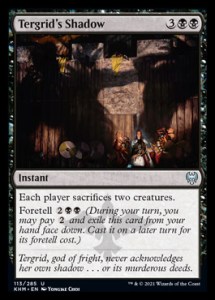
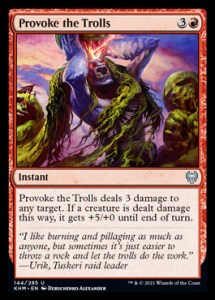
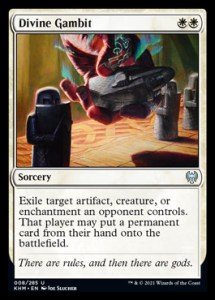
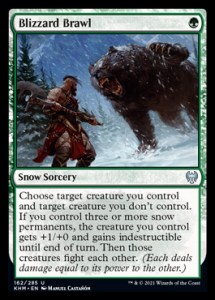
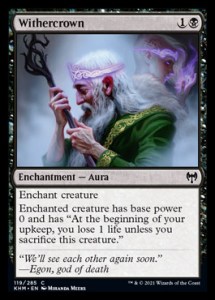
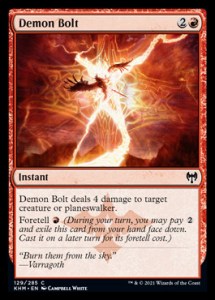
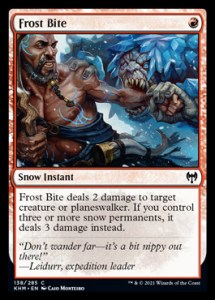
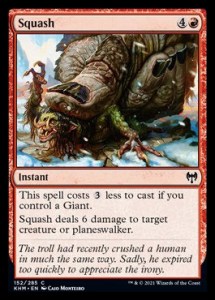
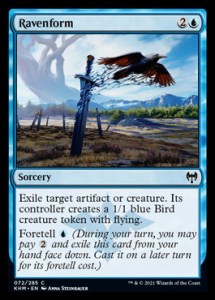
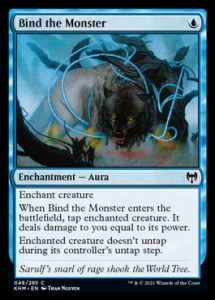
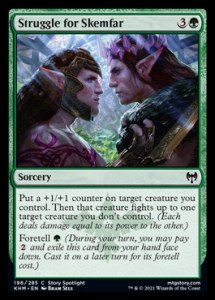
By the numbers, there are 16 pieces of removal, 5 of which are at uncommon. By comparison. This feels average-ish (Eldraine had 9 & 8, M20 10 & 3). The usual hits are here: three red direct damage at instant speed, a green fight card, white pacifism. Note that black has unconditional, instant, removal at common, so be wary of that. Also, blue looks unusually stocked with removal with two fairly unconditional options at common and two quasi-tricks (bounce and Slimebind) at common as well.
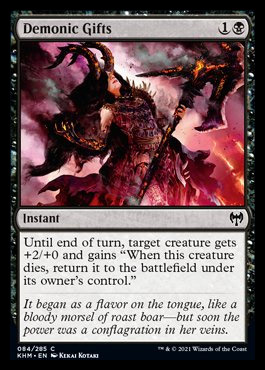
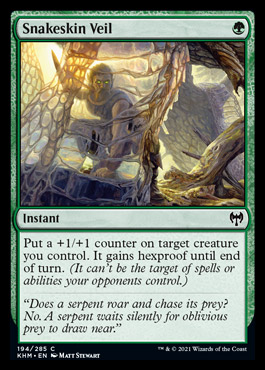
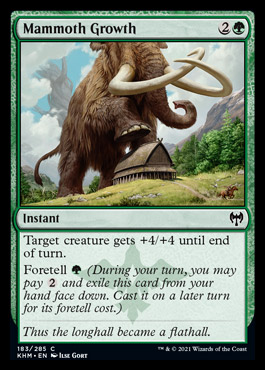
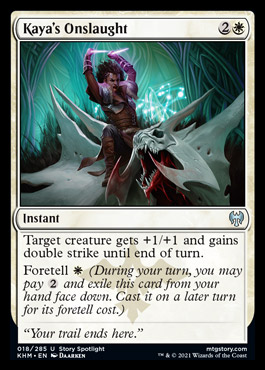
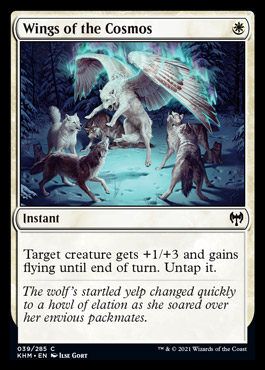
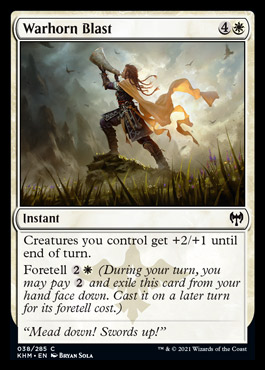
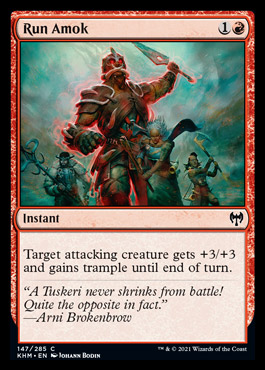
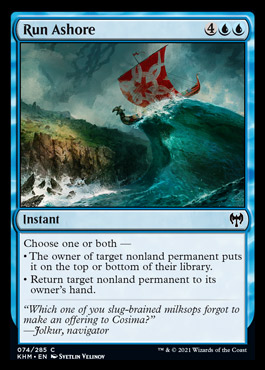
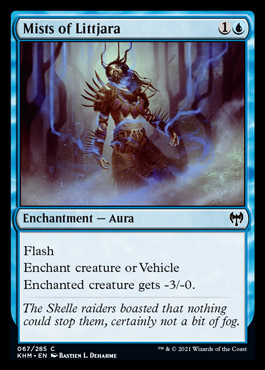
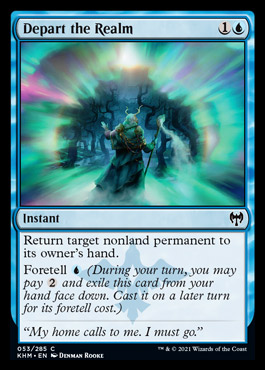
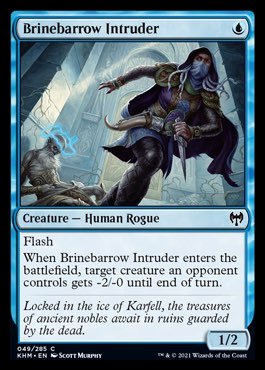
Okay, so basically nothing is safe. White and green have 1-mana plays, with and without foretell. Blue has a bounce spell at 1 mana (when foretold) and a pair of flashes that can impact combat math. Even black has a respectable option at 2-mana. As for red, well as is often the case red’s idea of a combat trick is a burn spell and they have plenty of those.
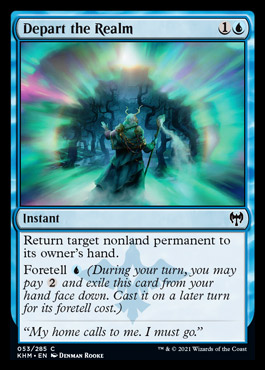
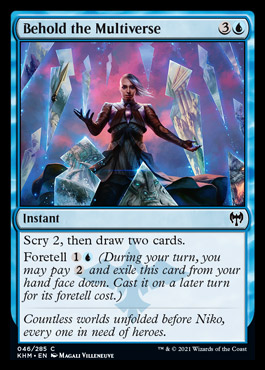
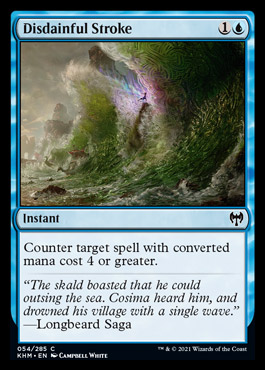
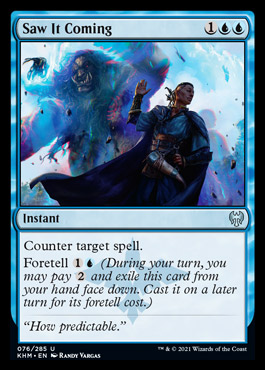
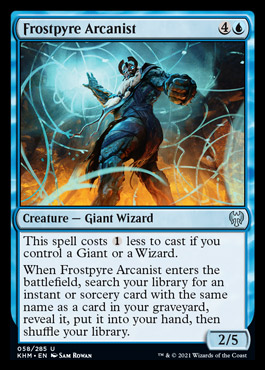
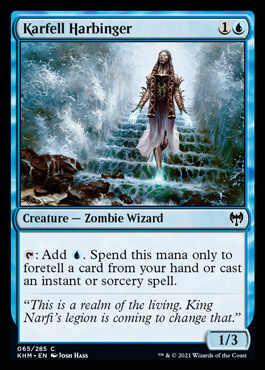
Nothing too odd jumps out at blue as it has its usual suite of tools. Bounce, card draw, counterspell etc. Note two pretty good options for counterspells, both at 2-mana. Looks to be a reasonable tribal theme, supported by changelings scattered throughout the set. No really aggressive creatures or tempo plays that I see.
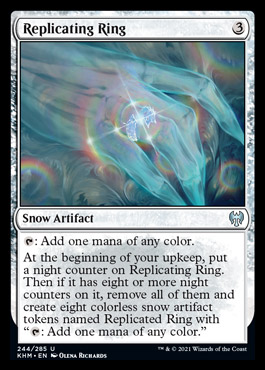
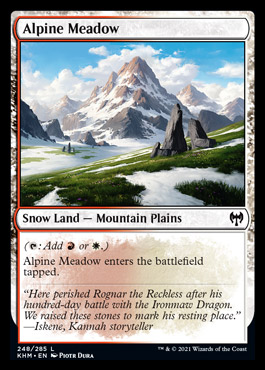
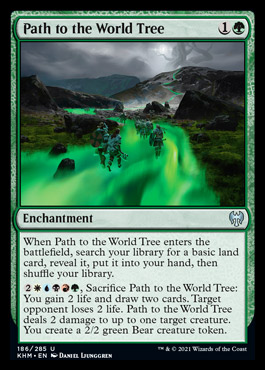
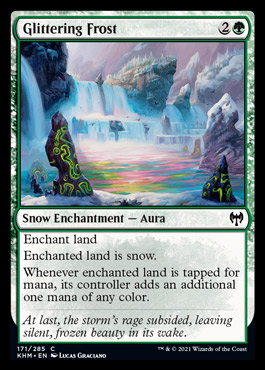
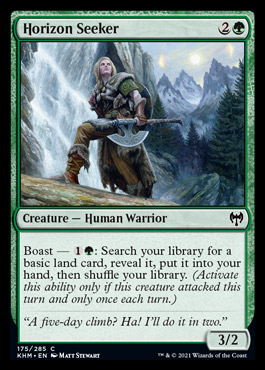
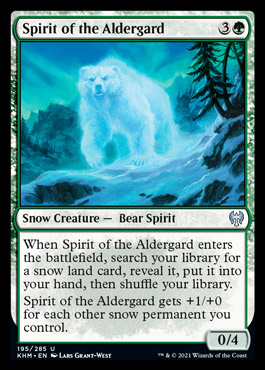
The artifact is at uncommon, so let’s just assume that’s not going to be a thing. There’s no Evolving wilds, though snow-dual-lands (the hyphens are getting out of control) will be in each pack (?). But green, green has the tools. Two at common and two at uncommon, covering both snow and regular splashing mana. There are a lot of gold uncommons (and the sagas) so 5C Green might be a source of great hilarity.
For Kaldheim, my New Set Resolution is to get more disciplined in my pick-orders. I usually have a good sense from listening to the podcasts and consuming content, but I don’t really formally study them and force myself to think about the difficult “A…or B?” choices ahead of time. And then I panic with 0:06 seconds left on the clock before making a choice. In a first for me, I actually went through the set blind and judged the cards, looked (a little) at the context, and tried to pick out the top three in each color. Let’s get to it!
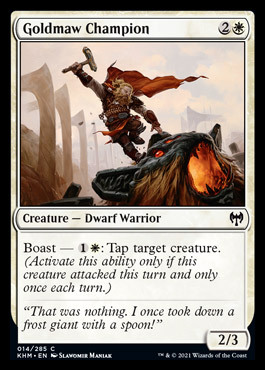


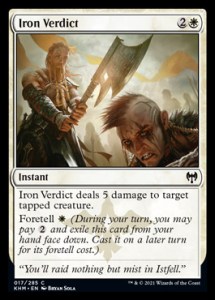
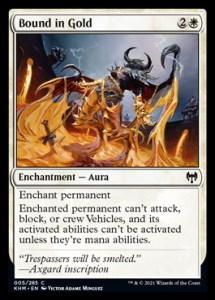
These are the five that jumped out at me. Territorial Hammerskull was an absolute beater, but I’m not sure if paying two mana for the same effect is going to get there. Axgard Braggart attacks as a 4/4 on turn 5 (when spending the two mana is less of a tax) and threatens to run away from the game if left unchecked. Iron Verdict is a pretty decent removal, but only when on defense or racing. Bound in Gold is our Pacifism for the set, bland but reliable. I’m actually highest on Gods’ Hall Guardian. 3/6 Vigilance is keyword: big for sure and there are a LOT of enhancements in this set (runes, equipment etc.) which scale very nicely on a creature that is playing both sides of the ball.
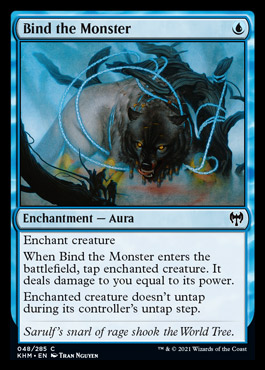


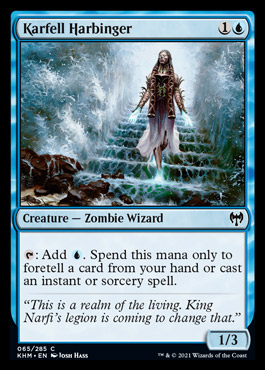
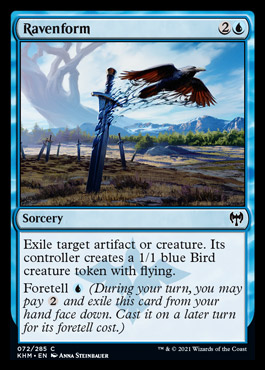

Blue has a bounty of riches to choose from! One mana removal (albiet one that damages you), a Phantom Monster on an installment plan, bounce, a mana-dork that can also defend early, another flexible removal spell, and a very interesting little flier that can loot for you too. I think the unconditional removal is clearly in the top two. As for the third, I think the Pilfering Hawk is going to overperform. As a flier, it wears pants (enchantments and runes and equipment) really well and asking for just a single snow source to loot is pretty reasonable.


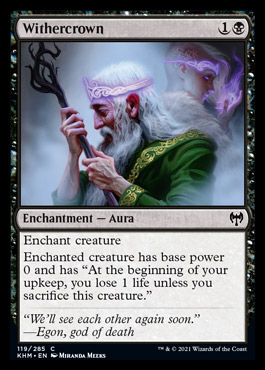


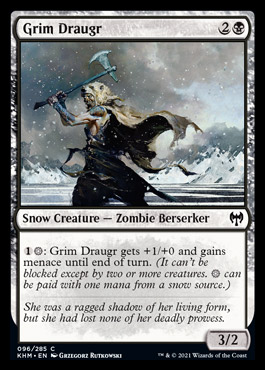
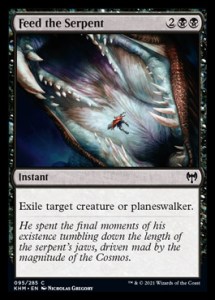
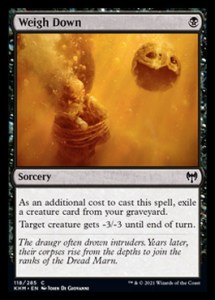
Black is pretty hard to read. Well, the three excellent pieces of removal aren’t that hard to read. 4-mana unconditional instant-speed removal is gas. The other two are more odd: one is efficient but can’t be played without something in the graveyard, which slows it down. The other is a slow drain but the creature can still stick around to block if you’re around. Still, I think most decks would happily run either of them.
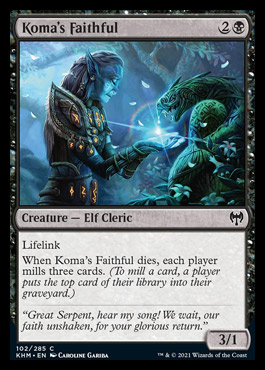
The creatures are weirder. A ‘cast two’ payoff that can get ridiculous in a hurry, but clearly has a deckbuilding cost. Koma’s Faithful looks to be in slower decks, as a blocker that can trade up aggressively and stock the graveyard AND gain some life as a buffer. Finally, Grim Draugr looks like an absolute beater that can attack as a 4/2 with menace with relatively little work. So black looks to be doing a little of everything!


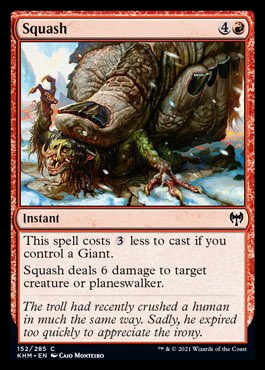
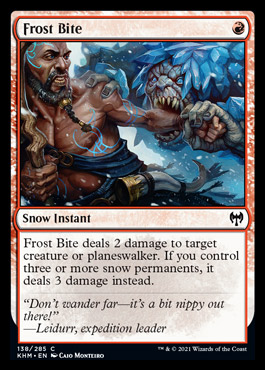
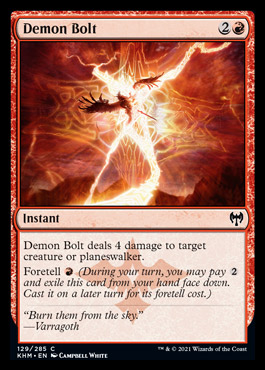
So which direct damage spell is your favorite? Ah red: never change. The first question is how easy will it be to have three snow permanents (note: not JUST snow lands) to upgrade Frost Bite from Shock to OG Lightning Bolt (that can’t go to the face). Demon Bolt being able to pay on the installment plan is a strong contender. And Squash (great name) hinges on how easy it is to get a Giant on the battlefield (red has two at common). The 3-drop that draws you cards (sort of ) for 1 mana I think is going to shockingly overperform, though I don’t think it’ll make the medal podium. Finally, the equipment that is a Short Sword that also pings the opponent could really rack up the damage and enable some attacks. Since red appears to be exclusively turning cards sideways, I think it’ll find a home in every deck.
Frost Bite vs. Demon Bolt is a close one. If snow is easy to put together, I think the higher ceiling on Frost Bite bumps it to the #1 slot. If there’s only one or two “snow” drafters at the table, then it’ll probably be Demon Bolt. Which is where I’ll start.
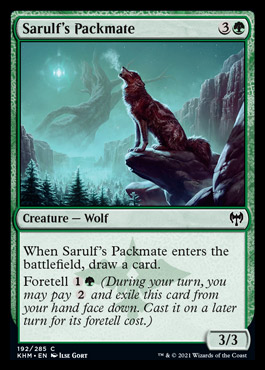

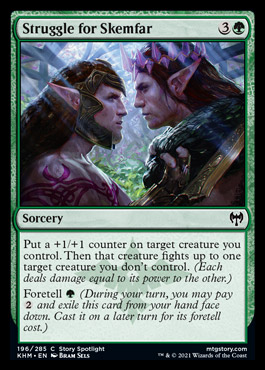

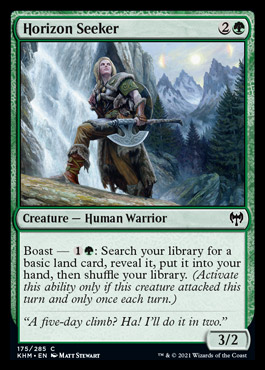
Green is interesting. Elvish Visionary keeps getting stronger, since now we’re up to a Hill Giant that draws you a card AND can be paid in installments. Glittering Frost I think is going to be a key component of Snow decks, since it creates two snow permanents and generates two pieces of snow mana. Hunt the Weak I think will be fine. The Troll Warrior looks to have a super scary threat-of-activation that will be hard to block. Finally, a 3-mana go-get-a-land that will also–almost certainly–trade for a card looks to almost be a 2-for-1 more often than not. I see a lot of splashing in green’s future!
Okay! There it is! My best theorycraft without doing my usual cheating on LR and other set reviews. Let’s see how these hold up, what changes in context, &c &c. Thanks for reading.
It is known that one of the best payoffs of parenting is indoctrination. Yes yes, we all want to avoid the pitfalls of forcing your child to dance to the dreams of the parents. But wouldn’t it be AWESOME if you could get them to play Super Mario Bros. 3 with you in two player mode and enjoy what you grew up with? Let’s just leave aside the fact that you would be trying to get them to enjoy a 30-year old game.
Anyway, the Benalish Momma leaves me to do daycare drop-off in the mornings. This means I have total control over Lil’ Chandra’s sensory inputs for ~15 minutes a day. To some this might not sound like to much. To those I say: you lack vision. So let the indoctrination begin with… orchestrated video game music!
It’s a pretty short jaunt from playing video games, to listening to video game music (litereally designed to be easy background listening) to then getting classy and enjoying orchestrated video game music.
It’s worth noting that I’m allowed to listen to this on the Sonos only while cooking. The moment–and I really do mean to the second–the cooking is finished, the Benalish Momma smoothly changes the channel back to KEXP or something similar. What’s particularly amusing about this is that this house rule grew up organically without ever being explicitly discussed.
I want to be clear that the payoffs are worth it. Is it incredibly adorable when your toddler requests, “Center of Commerce”? It is! Side note: Octopath Traveller was a JRPG with a fantastic battle system, truly astounding music, and was deeply hollow with how they set up the episodic plot. Happy to rant about this in the comments.
I’ve been getting more ambitious lately. I introduced one of the battle themes but called it the “Jumping music” when Lil’ Chandra was feeling bouncy. Now she also requests, “Decisive Battle” from time to time. Success!
Finishing with two trophies and a freshly regenerated pile of gems seems like a good place to stop and review the set. Just how far did Zendikar rise anyway?
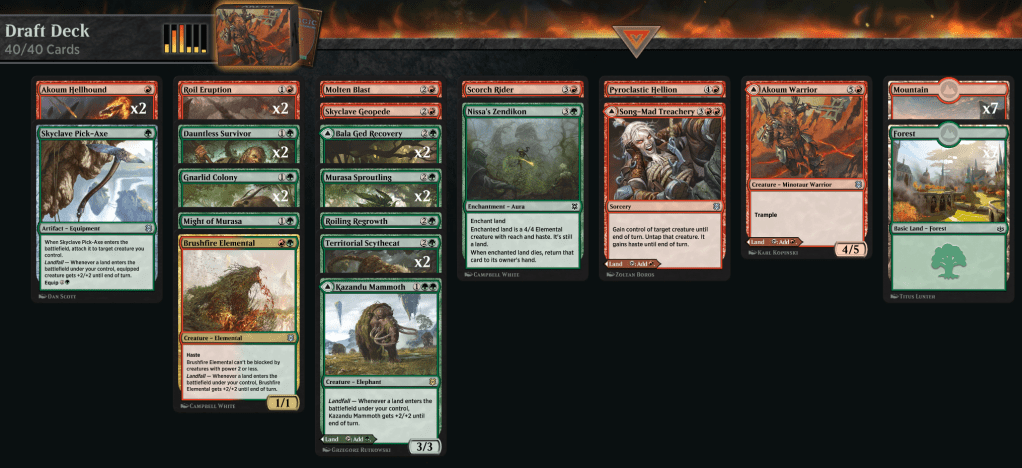
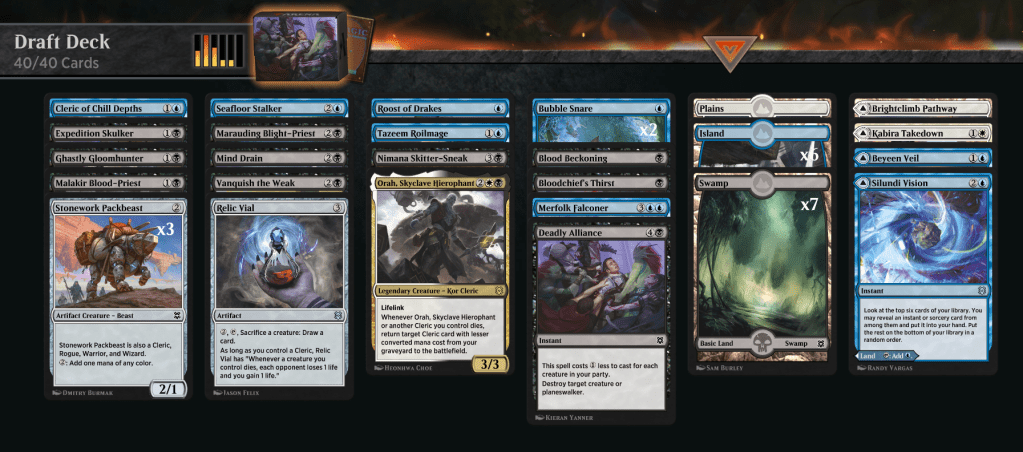
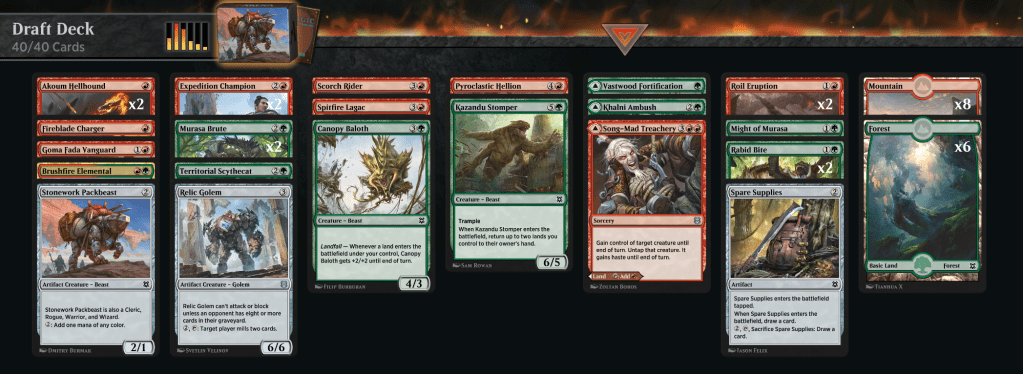

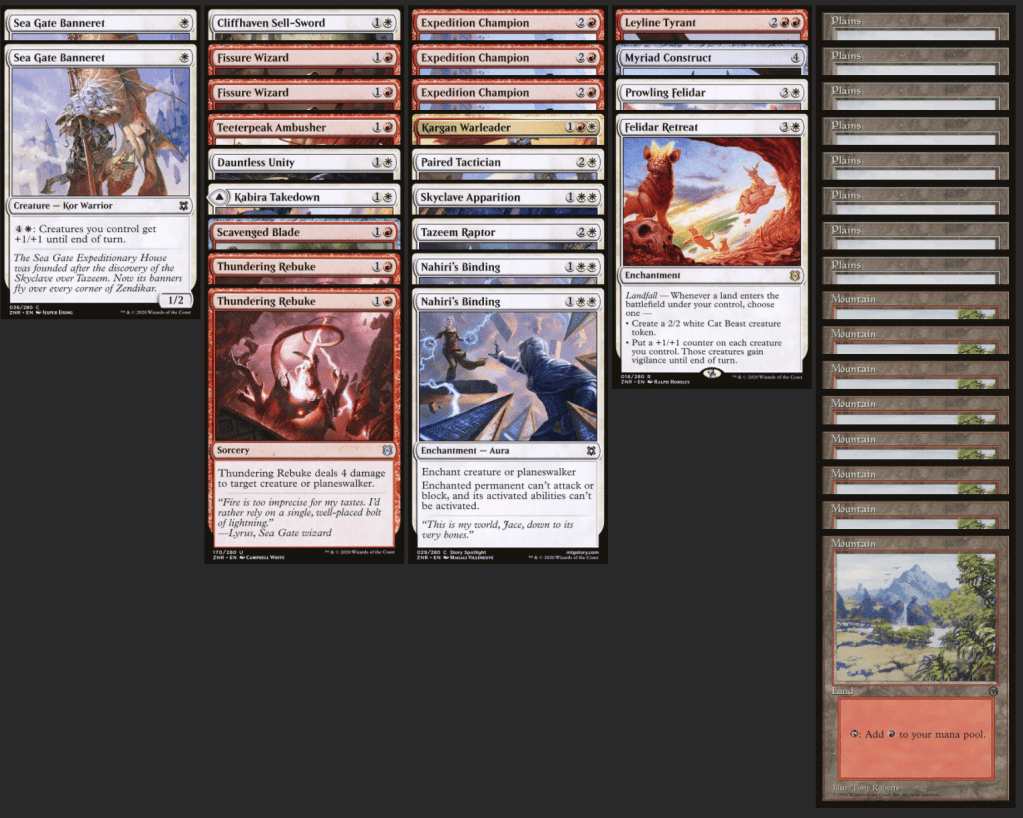

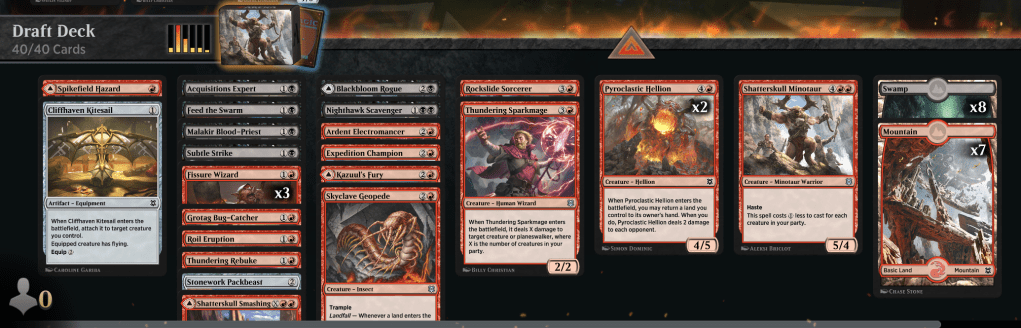
Interesting looking at my trophies (the one missing is an RB party deck). Literally they all have mountains! All of them! And red was a pretty good color, but far from the best color in the set

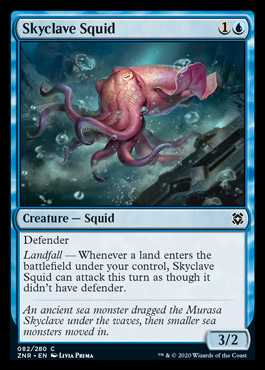

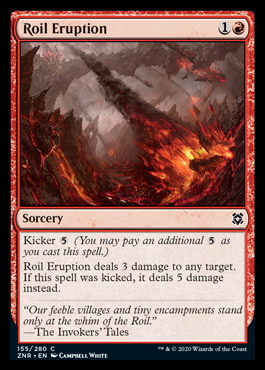
Not too surprising that all my red trophy decks probably indicated drafting a lot of red. Fissure Wizard was #1 with 27 picks. Roil Eruption in the four-slot with 19 though, which is impressive for a card as good as that. Good cards are rarely among the most drafted since they tend to be a lot more contested than filler-esque cards like–well–Fissure Wizard.
Zendikar III: The Sequeling was the first set of magic where I did some coaching with Ethan from Lords of Limited. Like all things, it turns out that having an expert watch with you and pointing out mistakes offers a lot of learning potential. In particular, I think I drew two lessons:
Picking out Pack 1 Pick 1 is an exercise in raw card evaluation. And while there will always be some room for discussion as to power level, flexibility, &c. it’s a single question. However, after that pick now the question mutates: what’s more powerful versus what fits in your deck? The heuristic I adopted is to always pick two cards: the raw power “P1p1” as well as the best card that goes with your previous picks. Then weigh the power level of the two picks. This makes it easier to carve a lane as well as be aware that it’s time to change lanes.
You can’t change your plan if you don’t have a plan in the first place. After picking your 40, take the time to craft a plan for the deck. It doesn’t have to be an essay, just a sentence or two. Aggressive or controlling? Are there key cards to draw? Do you want to aggressively trade resources or not? Then, once you have that, it makes it a lot easier to look at your hand and come up with a plan for that. Are there any particular gaps in your initial card draw that would change the plan?
Finally, once you have all of those, it’s easier to track the board state too. You get to go from “I want to be the beatdown deck” to “I am the beatdown” to “Oops, I’m not beating down anymore, I need _____”. My goal with this is to make sure I identify key moments of the match where I shouldn’t make the automatic, mostly-correct play.
30 drafts with 8 Trophies and a 62% win-rate. Honestly one of my better performances lately as I’m usually in the high 50s. Late time I was in the 60s was when I was stomping faces with Gruul in RNA. Which come to think of it, also had me playing a bunch of mountains. My god, what if I’m a red mage at heart?! (shudders)
I enjoyed Zendikar Triplicate, though I certainly agree with the criticism that the overly strong tribal decks led to drafts and games being on rails. However, when I only drafted 30 times, that reduces my burnout factor. The party mechanic has a lot of potential, even if it didn’t quite reliably get there. Any set with Kicker is going to be enjoyable and I look forward to seeing more of the spell-lands (or MDFCs if you insist) in future sets. I think it’s a solid B, maybe B-. I’d rank it behind the most recent Theros set but ahead of most of the core sets.


 Benalish Dad