A recent LR had an entertaining roundtable discussion that touched upon the white’s low standing over the past few sets. While I think there’s a hefty amount of recency bias (it wasn’t too long ago where white had a surplus of unstoppable bombs), one of guests said something interesting: white totally lacks an identity and this leads to a lot of variance in strength from set to set.
One of the things that has made Magic enduringly great is how well they nailed Alpha. It’s tremendous how many mechanics and “color identity” remain a solid foundation 25 years later. Green (mana-elves & big creatures) ramps, blue (Divination, counterspells, fliers) controls, stabilizes, and gains resources. Red (Shock, haste, menace) attacks early, often, and hard. Black (doom blade, deathtouch, sacrifice) has great removal and win-conditions. Now they all don’t do this in every set but having a coherent identity makes it easier to design and play. Let’s throw in a favorite Rosewater-ism: constraints breed creativity.
Conspicuously missing from the list above is white. White is defined by, uh, stuff? Being good? Justice? Let’s try and define this a little better by looking at what I would consider these the exemplar white cards from Alpha.
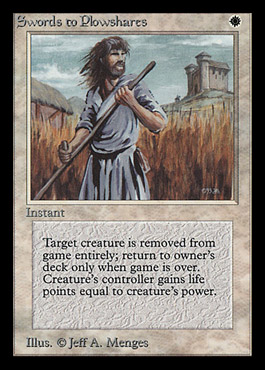
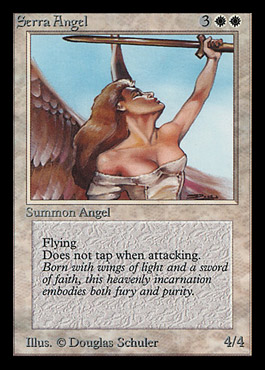
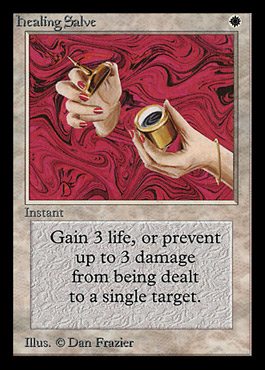
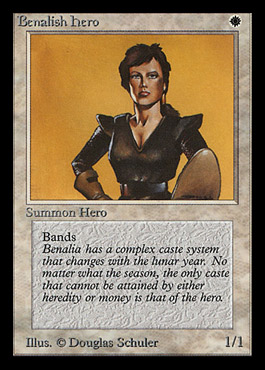
Swords to Plouwshares: hyper-efficient removal that also helps the opponent (we’ll come back to this). Serra Angel: a powerful flying Angel that stabilizes both the defense and strikes out on offense. Healing Salve: the worst of the “+3s” (Lightning Bolt, Giant Growth, etc.) because healing doesn’t help you win games, it just keeps you from losing. And finally, Banding. The source of more playground fights than handball rules, it’s also the only original ‘color-defining’ mechanic from Alpha that has been discontinued.
It’s easy to see here how the building blocks of white are more compromised than other colors’. One is gone, one doesn’t win games, one was too powerful, and one isn’t unique (after all each color has an angel, they just call it a djinn/dragon/demon/elemental). Let’s dig deeper into ‘why’ and suggest some potential fixes.
Vigilance
Vigilance is white’s defining keyword. But it’s a funny ability because it’s either really strong or mostly pointless. Vigilance shines on a big creature that can power on the attack forcing bad blocks while also sitting back and defend the fort. In fact, it’s almost too good since Vigilance on a beefy creature can do more than just stabilize a bad situation, it can singlehandedly turn it around! That’s part of what makes Serra Angel such a great card. It blanks their attacks and punches them in the face.
Yet, somewhat ironically, it is frequently irrelevant on small (or even medium)-sized creatures. Example: you have a 3/2, opponent has a 2/2. Are you attacking? Well, it depends on a lot of factors. But whether or not it has vigilance and protect you against the crackback rarely enters into it. If you have a good attack, you’re going to attack. The fact that it can also sit back and chill on defense rarely comes up. Compare this to a 2/2 flying creature. Relevant! A 2/3 reach creature. Relevant! 2/2 haste creature. Relevant! The other foundation keywords play well on big and small creatures, where vigilance only really adds value on the big.
One avenue that I haven’t seen explored yet would be giving a creature Vigilance *and* some sort of tap ability. Example, “2W 1/3, Vigilance. Tap: target creature gains +1/+0. So it can attack as a 2/3 or play defense with threat of activation as a 1/3 attacker.
Lifegain
Gaining life in Magic is not a strategy because it can’t help you win. Even the most humble 1/1 can win a game, given enough time. Wizards clearly knows this and you can see Wizards playing around in this space.
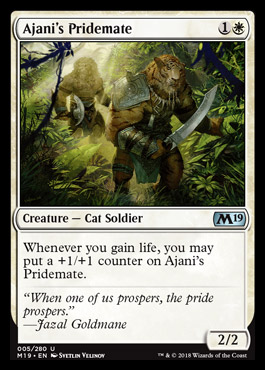
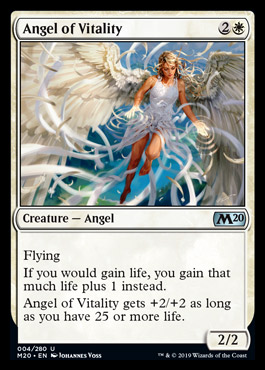
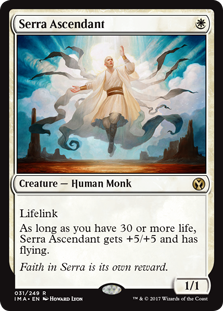
But it’s clearly tough to figure out the right balance here. Many of these cards are simultaneously “win more/lose more”. If you’re ahead, suddenly you’re casting a 4/4 flier for three mana (or better!). Woo! But if you’re losing or under pressure, you just have a 1/1 sitting there not helping in the slightest.
One interesting idea might be to take the “life total” question and bracket it depending on if you’re high or low on life. Example: 3W 2/2 Flying. ETB: If you have more than 25 life, it gains two +1/+1 counters. Otherwise gain 4 life. Are you under pressure? Gain some life, trigger Ajani’s Pridemate, etc. Or if you’ve stabilized and drew your other lifegain cards, now you have a win condition. This helps fill out the Quadrant Theory a little more.
Apologetic Removal
Swords to Ploughshares I think deserves the closest reexamination. White’s removal has nothing unique. It either apes Blue’s imprisoning or Black’s unconditional-but-expensive.
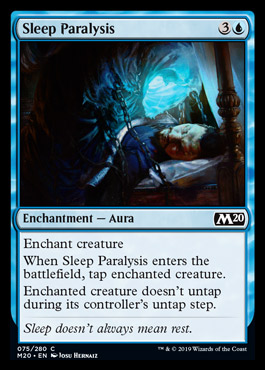
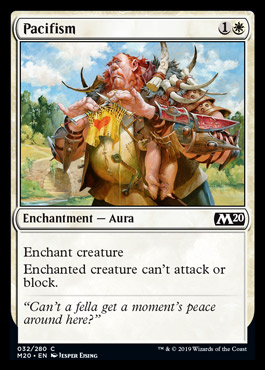
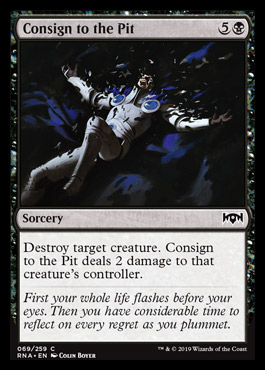
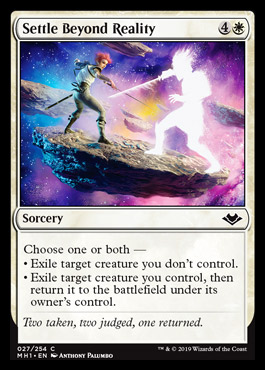
“But wait!” you cry, “What about O-Ring?” Folks, it’s time for some real talk: Oblivion Ring is just a slightly better Pacifism/Claustrophobia. Yes, there are some differences, but the fundamental feel is the same. Same vulnerabilities (bounce, Naturalize). If O-ring was suddenly a blue card, it would feel just fine.
I think M20 has come across the answer: removal that benefits the opponent, just like Swords to Ploughshares.
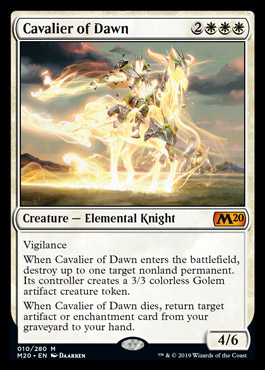
They’ve played around with this before; the “destroy something… but also GIVE them something” has some rich possibilities. Whether it be drawing a card, gaining x life, a replacement creature, &c. it feels very on-brand for white and I think makes for some interesting gameplay tension. For example, imagine “2W Instant, Destroy Target Creature and controller gets a 3/3 Golem.” This makes for an interesting choices in an aggro deck. Sure it can handle their bomb, but you still have to fight through the blocker it leaves behind. Do you cast it on your own 2/1? Hold it up to negate a piece of their removal?
banding together
At last we come to Banding. I have a soft spot for banding, since creating Voltron with banding white weenies was my first true deck love. Banding was a clumsy mechanic, but I think it’s worth trying to return to what is was getting at: cooperation. White is the cooperative color! They team up to make each other better! Teamwork makes the dream work!
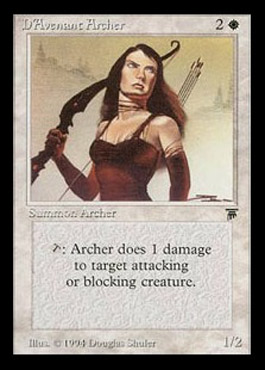
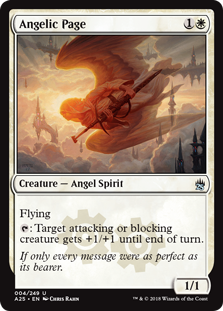
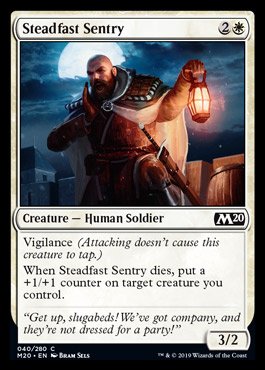
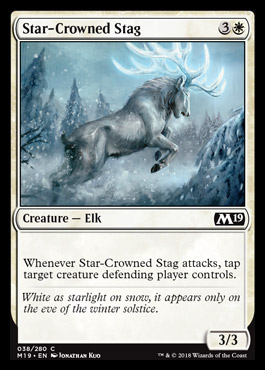
What I like about these is that they can be fine on their own, but they really shine when they have friends. The “tap-attacker” like Star Crowned Stag verges on being too powerful, but enabling its smaller friends to swing in feels very on theme. I like the on-death trigger on Steadfast Sentry in white more than black. The ‘tap-helpers’ of Archer & Angelic Page can be very powerful as well, making for interesting attacks and blocks. I know some of these have been discontinued because the power level is too great (there’s a reason why Angelic Page was last seen in a Masters set), but I think there’s room in the design space.
I could go deep down the rabbit hole and start inventing mechanics that reward cooperation. Proposal: Flanking 2.0. Creatures blocking this creature gain -1/-0 for each other attacking flanking creature. So a single nu-Flanker attacking gets no benefit. But if two flankers attack, each of their blockers would get -1/-0. Or Support. If this creature is unblocked, you can chose for it to deal no damage. If so, target creature gains -X/-0, where X is equal to this creature’s power. This could give some legs to a go-wide strategy without the feast or famine of being unstoppable or too easily stopped by a single 3/3.
It’s important to distinguish “cooperation” from the current “go-wide” niche of white. In the modern era, the closest white has to a semi-consisent game plan is the classic ‘white weenie’ strategy where you go wide and finish with a pump spell. Unfortunate, like all combos, this is very delicate: you need to curve out with your 2-, 3-, 4-drops and then the pump. Drawing the pieces out of order completely botches the plan. Instead, try to find cards that can stand on their own but also really shine to make other cards better. So your 2-drop topdeck might not be a complete blank if it has the Angelic Page ability to help push a different creature through.
Anyway, white will always be my first love (just look at my author symbol) so I hope that they are able to buckle down and find a good identity that helps them Make White Great Again…. Huh, that really doesn’t good when put that way, does it?
 Benalish Dad
One thought on “What’s the matter with white?”