First, I learned to reliably spell “Allegiance” without relying on the spellchecker. Two e’s, one a. Got it. Beyond that I had a pretty good run I’d say! Let’s look at the tape:
| Drafts | Wins | Losses | Win % | |
| Azorius | 5 | 7 | 6 | 54% |
| Orzhov | 5 | 11 | 4 | 73% |
| Rakdos | 1 | 0 | 2 | 0% |
| Gruul | 9 | 16 | 10 | 62% |
| Simic | 3 | 7 | 2 | 78% |
| Gates | 4 | 8 | 4 | 67% |
| Other | ||||
| Total | 27 | 49 | 28 | 64% |
I’m honestly pretty happy with a 64% win-rate. Kind of funny that I barely draft Rakdos and a full third of my drafts ended up in Gruul.
Card advantage in aggro
I definitely got most comfortable drafting the Gruul deck. It is known that the flexible 2-drops, “good on turn 2; good on turn 10” are solid gold. Sauroform Hybrid is the absolute gold standard here. However I think everyone initially undervalued aggro cards that provide a little bit of card advantage.
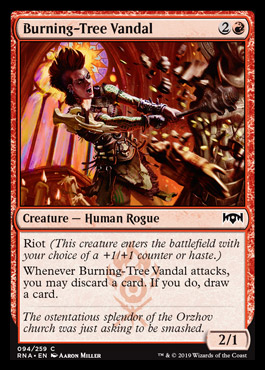
The Burning-Tree Vandal did not look great in theory. Three mana for 2/1 haste or 3/2 rarely lines up well (especially with 1/1 Spirits assumed to be floating about). But 2/1 was shockingly good in this format. The lack of 1/3s & 2/3s meant that the 2/1s were every bit as good as the generic 2/2, plus you get to rummage! Having BTVs as built in flood insurance really helped aggro decks prevent one of their surest paths to defeat.
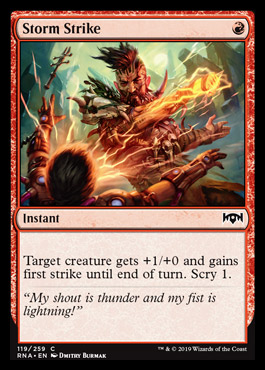
Similar story with Storm Strike. The +1/+0 and first strike was enough to reliably win most combats in this set (real lack of 4 toughness) and the scry 1 was just solid gravy. Add in the flexibility of a 1-mana trick and you had a card that I loved running multiples of.
PS: 1-mana tricks remain the gold standard
Drafting is hard
This was probably the most I’ve played a single set in a long time. I put a lot of time in! And I still only really learned how to draft one deck! It’s hard to learn decks. Only really got good at Gruul. As much as I like to theorycraft and listen to how to build good decks, there’s really no replacement for playing with the cards, getting a feel, and then getting a feel for what will wheel. Magic is hard.
Most Drafted: Greeeeeen!
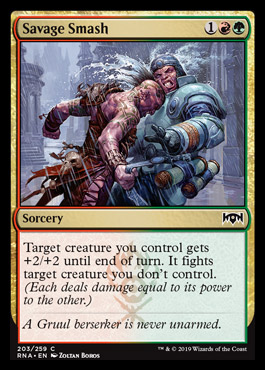


Three-way tie for most drafted card. Aren’t they pretty? Sauroform Hybrid is a testament to how early I’ll take a card that will go into any deck with forests and be a reliable C+. Savage Smash is a solid removal spell that only really asks that you have a 2/2 in play: pretty manageable. The Axebane Beast is a funny third choice, since I would just scoop them up with my 13th-15th pick and occasionally play them! Obviously there were many better 4-drops in the set, but if the Frenzied Arynx’s never made it, you could throw in ol Axey and not feel too much shame.
Mulligan
So, I added a heuristic: never keep a hand that needs to draw particular color of mana to work. Assuming you have 8 sources, our friendly calculator puts us at 43% to draw one within two draw steps. It goes up to 57% percent with a third draw step added, but that can be dangerously deep into the game, especially if you’re on the play. Keep in mind I define “work” as “get something onto the battlefield”.
The second lesson is for me to aggressively mull hands in an aggro deck that are not exerting pressure. Once I had a hand that had four lands, a 4-drop, and two spells. In a Gruul deck. If this was a control deck, it’s a snap-keep. But I had an aggressive curve and doing nothing for three turns was almost a sure loss for me. Aggro decks often function best with virtual card advantage: killing your opponent while they still have cards left in their hand is the same as if they never drew them. Again, most decks are shades of midrange so don’t get carried away mulling TOO much. But the more you’re hoping to get work out of your 2-drops, the more you should mulligan hands without them.
 Benalish Dad