Apparently the people love theorycraft! They might not love it quite as much if they knew my MTGO rating but we can keep that a secret. Let’s use the taxonomy (Bomb, Accelerator, Splash, Signal, Payoff) and look at a few more fun ones and do some analysis.
Tiana, Ship’s Caretaker

Everyone widely agrees that Tiana just doesn’t quite get there. But why? You can see the tension right there in the card design. A 5-mana gold card usually resides in the Splash territory, just due to its high casting cost. This is fine; there are other 5-mana 3/3s that pull their weight just fine (Tatyova, Arvad, etc.). But the problem is that her ability is most effective early, not late. You want to be able to cast Tiana then play your Auras so they’re protected. The Auras in Dominaria are medium at best and they’re all cheap. Are you really holding on to crappy Auras in an aggressive deck to wait for Tiana? The question answers itself.
Imagine Tiana had the same ability but the following stats: 1RW, 2/2 First Strike. That’s a much better card, right? Faster in the RW aggro deck means it races better and the cheaper cost sequences her better with Auras. Or switch it around: keep the 5-mana casting cost but change her ability to “ETB: return an Aura or Equipment from the graveyard to your hand”. Now you can play Auras aggressively and early. If you get 2-for-1ed by opponent’s removal, you can get a card back with Tiana late.
There are formats where just being a 3/3 flier can be very powerful… but with Mammoth Spider (3/5)and Cloud Sphinx (3/4) running around at common, Dominaria ain’t it. As it stands, Tiana is neither efficient enough to be a Payoff in RW nor powerful enough to be a Splash outside of that.
Slimefoot, the Stowaway

This card provides a really interest boundary case on what defines A Bomb. Bombs win games and they can also bring you back from a losing board state. The very best do both at once. The good (in Limited) Planeswalkers generally have a plus-ability that helps build the board state, a minus-ability that answers threats, and ultimate that provides inevitability. Non-planeswalker bombs are often huge, stabilizing forces that also demand an answer (say, a giant 7/7 flyer or such-like). It’s not that they can get you out of EVERY losing situation, but they are the card you are most wanting to draw when feeling behind.
Which brings us to Slimefoot. Again, it’s instructive to tweak the abilities slightly and see how it changes. Imagine Slimefoot read: 1GB, 3/3, Drain 2 each time a Saproling dies. This is a pure build-around, a Signal like Adeliz. Without other cards to create Saprolings, Slimefoot is just an efficient 3/3. Now let’s tweak the other way: 1GB, 3/3, create a Saproling for 4 mana. While this iteration can stand alone better than the other hypothetical, it doesn’t feel very inevitable. Even with lots of mana and a stalled board state, it will take an impossibly long time to alpha-strike with a bunch of 1/1s. So it really is the combination of the two that makes Slimefoot so great. It puts your opponent in the world’s tiniest Sophie’s Choice: either they don’t block and take a point of damage or they do block… and take a point of drain. In a slow format like Dominaria, I think Slimefoot qualifies as a one-card win condition, a classic definition of a Bomb.
The stabilizing question is another side of the coin. Slimefoot is relatively cheap, but he takes a lot of time to get going and doesn’t block very well at all. If you’re already behind and your opponent is beating down, grinding out a few Saprolings and a few points of life isn’t likely to swing the board. Again, not every Bomb is going to stabilize in every situation you find yourself behind… but Slimefoot seems unusually bad in most of them.
As such, I think you can view Slimefoot either as the highest possible Signal (sweet build-around with tons of upside) or the bottom of the Bomb. To me, I view it more as the former. If I ask myself, “How much am I willing to contort my B/U deck to shoehorn in a Slimefoot?” my answer is: not a lot. Whereas if I ask myself that about Tatyova, Darigazz, et al I answer “A lot”. However, the moment you start to get some Saproling generators and/or sacrifice engines (Soothsayer, Omnivore), Slimefoot starts getting a lot more appealing. I think it’s easier to get Slimefoot to an A than Adeliz, which counts for something.
Muldrotha, the Graventide
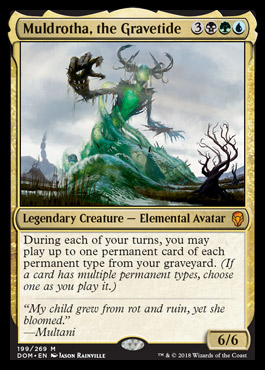
A bomb, but at what price? Nobody denies the power level of Muldrotha. A 6/6 instantly stabilizes the board, is out of range of all damage-based removal, and starts providing some serious card advantage by bringing back any permanents you have over and over. These check all the Bomb boxes. The catch: it requires Sultai mana to case in a format where splashing is extremely difficult. The good news is that you need green, so at least you have access to Grow from the Ashes. Which is nice, because you won’t be seeing any Skittering Surveyors past pick 3 it seems like. But again, you need to be at six mana anyway and the power level is very real, and Dominaria both gives you time but also demands Real Power. So in this set, I would draft this highly and fight hard to make it work. Grab the card draw from Black & Blue, use the Mill Giant on yourself, whatever it takes. This card wins games and very few cards can say that.
 Benalish Dad